Overview
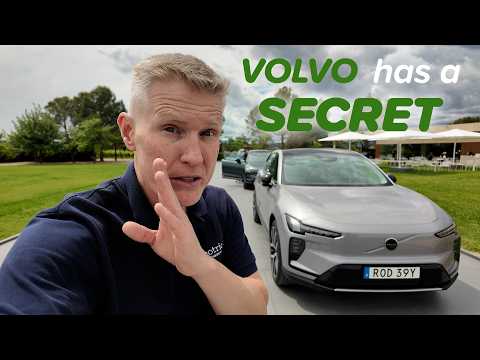
This is a first-drive review of the Volvo EX60 (referred to inconsistently in the transcript as the EX30 and XC60), filmed at the car's global press launch in Spain. The presenter, from New Zealand-based green energy company Ecotricity, covers the model lineup, technical architecture, design features, and on-road impressions, and includes a brief interview with a Volvo designer. It is a solo presenter-led explainer with one short interview segment.
Bottom Line
The episode gives a practical overview of the EX60's specifications, technology, and driving character for someone considering the car or tracking the EV market. It is light viewing — accessible and conversational rather than technically deep. It will be most useful to people already interested in the vehicle; those wanting rigorous analysis or independent testing data will find it thin.
Key Themes
- Model lineup and specification differences
- 800-volt architecture and charging speed
- AI and infotainment technology
- Exterior and interior design choices
- On-road handling and driving feel
- Range figures across variants
What Was Discussed
Model range The EX60 is offered in four variants. The base P6 produces 275 kW, is rear-wheel drive, and offers 611 km of range. The P10 adds approximately 100 kW, switches to all-wheel drive, and extends range to 660 km despite the larger battery demand. A forthcoming P12 will produce 500 kW with a claimed 0–100 km/h time of 3.8 seconds and over 800 km of range. The Cross Country variant shares the P10's drivetrain but adds adjustable air suspension, raised ride height, and additional body cladding.
Platform and charging The car rides on Volvo's new SPA3 architecture, which runs an 800-volt electrical system — compared to the 400-volt systems common in many current EVs. The battery is integrated as a structural element of the chassis. Volvo claims 10 minutes of rapid charging delivers approximately 340 km of additional range.
Technology The infotainment system runs on Android, powered by a Qualcomm Snapdragon chip, and connects to the Google Play Store, allowing third-party apps to be installed directly on the car. Google Maps is included as standard, with charge-on-arrival predictions built in. The car also features an AI assistant — described in the episode description as Gemini, though referred to during filming as "Claude" — intended to respond to natural language rather than fixed voice commands.
Design Externally, the car is described as conservative, with Thor's Hammer LED daytime running lights, LED matrix headlights, an active grille, and frameless windows and door mirrors. Traditional door handles are replaced by flush buttons on the B-pillar. A Volvo designer interviewed on-site explained the decision was driven by aerodynamic efficiency and a desire for a clean body side. Internally, the glove box has been relocated to the centre console, and door grab handles are designed with a soft-touch surface. Boot space was noted as generous, with a secondary under-floor storage area and a usable front trunk.
Driving impressions The presenter drove the P10 all-wheel-drive variant on Spanish motorways and back roads. Handling was described as composed and confident, attributed to the stiff mega-cast chassis and low centre of gravity. One-pedal driving was tested and noted as effective. The presenter reported that other reviewers at the launch shared similar impressions.
Notable Points
The claimed range of over 800 km for the P12 variant is presented as the episode's standout figure. The presenter notes this exceeds 500 miles on a single charge — a threshold that, if independently verified, would place it among the longest-range production EVs available.
The 800-volt architecture is highlighted as a meaningful practical differentiator. The claimed 340 km of range recovered in 10 minutes of rapid charging would represent a significant improvement over typical 400-volt charging rates, though these figures are manufacturer claims and were not independently tested during the drive.
The flush exterior door buttons, while noted as a clean design choice, raised a practical concern: the presenter questioned whether they would function during a power failure. No answer to this was provided in the episode.
The AI assistant demonstration produced an off-topic recipe for crispy potatoes rather than a vehicle function, which the presenter treated as a light-hearted moment. It did not provide a substantive test of the system's automotive utility.
New Zealand pricing had not been announced at the time of filming. The presenter speculated a figure above NZD $100,000, based on the car's positioning and feature set.
Worth Listening If…
- You are actively researching the Volvo EX60 ahead of its New Zealand (or international) launch and want a general feel for the car before a test drive.
- You follow the EV market and want a quick overview of where this model sits relative to current competition on range and charging speed.
- You are interested in the design rationale behind specific features, such as the door handle and interior layout, and want to hear directly from the Volvo designer.
Skip If…
- You are looking for a rigorous, independent technical review with real-world range testing, charging curve data, or comparative benchmarks.
- You have no interest in the New Zealand market context — a portion of the episode's framing (pricing speculation, road comparisons) is specific to that audience.