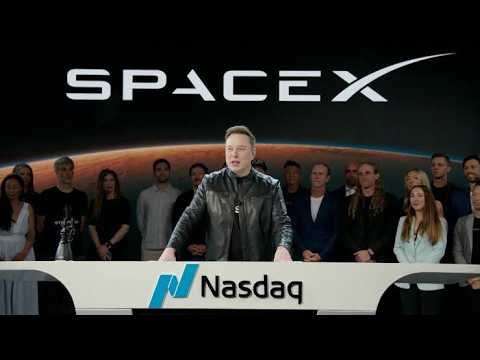
SpaceX Went Public - A Disaster Waiting to Happen
Transcript
give me $500 when I invested into
SpaceX. I I think I would. Yeah.
>> No, I wouldn't. You would not go
through.
>> No, but I hope my index funds aren't
automatically doing it.
>> Hi, welcome to another episode of Cold
Fusion. Space X is an incredible company
with impressive achievements. It brought
the price of space launches down by 85%.
Objectively, that is astonishing. The
company also made reusable rockets
reality. Many critics said that was
impossible. If you love your engineering
and physics, yep, great company. But now
there's a massive problem. Recently,
something has gone terribly wrong with
the company. It's no longer what most
people think it is. Let me ask you a
question. What type of company do you
think SpaceX is? You might say a rocket
cargo company that operates satellite
communications. For those who are more
optimistic, you could say that SpaceX is
an exploration company who will take
humanity to the moon and beyond. Well,
according to their own S1 filing, the
documents a company needs to file before
it goes public on the stock market. Both
of those answers are wrong. Generally,
S1 filings list the industry category
that a company is under. For example,
the industry code 3760 is for
spacecraft. 3182 is for defense and
aeronautical. Other companies like
Virgin Galactic, Boeing, etc. All file
under these categories. But for SpaceX,
they filed under the industry code of
7370.
That's computer programming and data
processing. Oh, it looks like SpaceX is
officially filing to be an AI data
center company. That already raises an
eyebrow, but it's worse than that. To
understand how, you first need to
understand what a TAM is. TAM stands for
total addressable market. It's the
maximum revenue opportunity available
for a product or service if you achieved
100% market share. It basically
represents to your investors what the
market for your product is. Looking at
the prospectus, SpaceX's TAM is 28.5
trillion, approximately the size of the
GDP of the United States. Okay, that's
pretty high. But that's not the bizarre
part. The strangest part is only 15% of
this market is space and communications,
and it's written right here in front of
your face in plain text on page 11.
So 85% of the company is essentially
just a rapper for yet another LLM and
data center business like Anthropic or
Open AI. I know some of you guys have
commented that you're getting sick of
hearing about AI, but this isn't funny
anymore. It's getting really serious.
When SpaceX went public, it was the
largest launch of any company in the
history of financial markets, larger
than Amazon, Google, Alibaba, and even
Saudi Aramco. In the first few hours of
trading, SpaceX blasted past a valuation
of $2.3 trillion, instantly becoming the
seventh most valuable company and worth
approximately the same as the country of
Canada. For some people, this seemed
like a sign of strength, but for others,
it was terrifying. The signs of an
overheated market. But that's not all.
The story of the SpaceX IPO is telling
us something if we listen closely. It
shines a light on the state of the
current financial market. A corporation
is hiding an AI company losing a billion
dollars a month inside the brand of a
perfectly healthy rocket company just so
investors fund it. Let me say that
again. In 2026, a corporation can
disguise an AI company losing almost a
billion dollars a month inside of a
perfectly healthy rocket company, sell
it to investors, and get away with it.
You know, your expectation is not going
to be a good investment. And that that's
the part that I'm trying to understand.
I found that that
never been a great bet to bet against
Elon.
>> I I I'll grant you all that. If you
again look at the S1, the TAM, the total
addressable market is defined at 28.5
trillion. 85% of that TAM is an AI. So
even if everything you say about SpaceX
and Starlink is true, the entire company
is being bet on AI in terms of of its
future, not on space and and not on
Starlink.
Those are his words, not mine.
>> It's a mess. And in this episode, it's
going to be a wild ride. And a
disclaimer, none of this is financial
advice. If you want to buy the stock,
buy it. If you don't, don't. But let's
get into it.
You are watching Toll Fusion TV.
>> There's a lot of excitement about what's
going to happen.
>> Everything they can possibly do to
guarantee a pop is being done.
>> This is going to become the largest
company on the planet.
>> For over two decades, SpaceX earned its
dominance the hard and old-fashioned
way. Three catastrophic early failures,
a near bankruptcy that must described as
existential, a methodically driven slow
rise, and finally a near monopoly on
orbital launches. In a company full of
moonshots, if we isolate Starlink, it's
the only thing that actually makes
money. The Starlink internet service has
a constellation of over 9,000 satellites
and generated 11.4 billion in revenue
and 4.4 billion in operating profit in
2025. But the rest of the company is
another story. And trust me, we'll get
to that. And from here, the controversy
begins.
When people talk about the broader
market, they're referring to the S&P
500. It includes all the big names like
Apple, Nvidia, Microsoft, and Amazon.
SpaceX had hoped to fasttrack its way
into the S&P 500 immediately upon
listing. This was essentially changing
the rules. They were essentially forcing
the general public to buy the stock.
Fasttracking its way into the index
would have forced every 401k and even
pension funds to buy the stock. This
isn't just American citizens we're
talking about, but investment funds of
everyday people all around the world.
roughly 14 billion of automatic passive
fund inflows going straight into SpaceX.
It would have been a massive wealth
transfer, but thankfully the index
committee said no. Why? SpaceX was just
too risky. To join the S&P, a company
first must be profitable in its most
recent four quarters. SpaceX didn't meet
the mark. Despite posting 18 billion in
revenue in 2025, which was a 33%
year-over-year increase, it lost 5
billion for the same year. So the S&P
500 refused to play ball and now that
$14 billion in passive funds is off the
table. But the NASDAQ, they said yes. So
there still will be some passive
funding. And because SpaceX will be
fasttracked onto the NASDAQ index, major
funds will be forced to buy some shares.
>> A lot of Australian investors will be
exposed to SpaceX whether they want to
be or not.
>> SpaceX spent years dismissing the public
markets. Elon Musk had watched what
quarterly earnings obsession did to
Tesla. For a company that measures
success in orbital mechanics in decades,
impressing shareholders in a 90-day
cycle seemed like a poor fit. In fiscal
year 2023, Spac X's capex was manageable
at 42% of revenue. And in 2024, SP X was
even profitable, clearing about 791
million in net income for an
expense-heavy rocket company. That is
remarkable. So, what changed? two
letters AI. In February of 2026, Space X
merged with XAI. Now, the company's
performance was in shambles. After the
merge, the required retrospective
accounting attributed to that net loss
of 5 billion we talked about in 2025.
XAI is a company that's bleeding so much
money that it needed the public to fund
it. Starink profits alone weren't nearly
enough. Career market analysts like
Michael McCarthy say investors should be
extremely cautious. No matter how we cut
the numbers, they simply don't add up.
>> In 2025, XAI was losing $2 for every
dollar earned, burning through
approximately $28 million per day.
Quarterly losses accelerated through the
year. By Q1 of 2026, XAI's capital
expenditure alone reached $7.7 billion.
That's an annualized pace of 30.8
billion, more than double the entire
prior year. In that same period, Spac
X's capital expenditure had gone from
that manageable 42% of revenue to 215%
of revenue.
Objectively, Spac X was a great company
by itself. There was no need to shove AI
into it. Every dollar that XAI burns is
a dollar that the rest of the company
could have used. So to summarize, in one
transaction, a focused aerospace
business became a conglomerate of
rockets, satellites, social media, and a
chatbot in the form of Grock. Up next,
we'll see some of the bizarre things
happening with XAI, and then we'll take
a close look at Space X's biggest bet,
data centers in space. But first, this
message is sponsored by Raycon. Finding
a gift that's actually useful is the
hard part. But Raycon's essential open
earbuds are one of those things I can
genuinely see getting used everyday.
I've been using them quite a bit
recently on walks, while running
errands, and even working from home.
What makes them different is the open
ear design. They sit just outside your
ear canal, so you can listen to music,
podcasts, or calls while still hearing
what's going on around you. Whether I'm
walking through the neighborhood or just
getting outside after working on a
script the whole day, I don't feel
completely disconnected from everything
around me. They're also incredibly
lightweight, and the flexible
multi-angular ear hook means that they
stay secure without becoming
uncomfortable. Whether I've worn them on
long walks, around the house, or during
workouts. After a while, you honestly
forget you're wearing them. A few
features that make this a go-to pair of
headphones is the open ear design, the
comfortable fit, and the multi-point
connection. I can switch between my
phone and laptop without having to
reconnect anything, and the battery life
is also excellent, up to 36 hours with
the charging case. I charge them maybe
once a week. Raycon now has over 3
million customers, and the sound quality
is right up there with the far more
expensive brands. Plus, they come with a
30-day guarantee, so there's really no
risk trying them out. I got one of these
for Mother's Day, too, and she started
using it as well. So, if you're looking
for something practical this Father's
Day, this is a great option. Upgrade
your dad's workout routine. Go to
byracon.com/coldfusion
open to get 15% off. Thanks to Raycon
for supporting Coldfusion. Now, let's
get back to these data centers in space.
Since AI is 85% of the company's
proposed market, we're forced to look at
how XAI is performing in the LLM
landscape. So users switch between Chatg
GPT, Claude, Gemini, and Grock
consistently. Critics argue that AI is
essentially a commodity at this point.
Nobody talks about Grock being the
market leader except for users on the
Xplatform. In fact, according to some
estimates, Grock only has 0.4% 4% of
enterprise use in the AI sector.
Enterprise is where all the money is. So
that's not a good sign. All right. Well,
maybe the management team is a
star-studded lineup of smart people, so
they'll figure it out, right? Well,
perhaps not. Musk founded XAI with 11
co-founders in 2023. Today, all 11 have
left. There's zero remaining. Okay, so
that's not encouraging, but that's still
fine. They can still make money by
selling compute to other AI companies.
Well, there's some problems there, too.
The deals so far don't give an aura of
confidence.
Google entered a partnership with XAI to
lease some GPU compute for $920 million
a month. Sounds great, but when you look
deeper into the deal, there's a strange
smell. Firstly, either party can
terminate the contract with 90 days
notice. Okay, that's a bit tenuous. But
reading further, you learn that Google
has a 6% stake in XAI. And there you go,
that smell gets stronger. It smells like
yet more circular financing with a
sprinkle of revenue boosting for the
SpaceX IPO season. Okay, so what about
Anthropic? Didn't they sign a deal with
SpaceX in May of 2026? Yes, but the way
that deal came about is hilarious. It
turns out that XAI screwed up the design
for their first mega data center. For
some reason, they built it with three
different types of GPUs. This meant that
the fastest GPUs were just sitting there
idle, waiting for the slower ones to
finish. The result was that AI training
only ran at 11% of full capacity
according to sources. Seeing that it was
useless for training, XAI decided to
rent out the data center and move the
training of Grock to a new one. So,
that's not a great sign in management
competence, but okay, that's fine. The
company can still make money with a data
center in space.
SpaceX has filed with the FCC to build a
space cloud of up to 1 million
satellites. Orbital AI compute is
targeted to begin by 2028, but launching
a million satellites is a lot. The
Starlink network has 9,000 satellites,
so imagine over 100 times that number
orbiting the Earth.
2 years ago, I literally moderated a
panel on Space Junk, and I was even on
the news talking about it. Although
SpaceX's satellites have autonomous
avoidance systems, coordinating 9,000
objects and coordinating 1 million
objects are two completely different
challenges. I truly believe that if we
don't want space debris becoming a hot
topic in 15 to 20 years, sending 1
million satellites into orbit with GPU
technology that will be outdated in 3
years just isn't a good idea. Or am I
the crazy one here? Maybe there's
something I'm missing, but it doesn't
look like a financially competitive idea
at all. In fact, it seems kind of
wasteful. It seems like even in the best
case scenario, with every new GPU
release from Nvidia, the orbital data
center will become less and less
competitive over time. In the worst
case, if LLM algorithms get vastly more
efficient or AI running locally on
devices becomes the norm, that seems to
me like a huge threat to the central
thesis of a space data center. But I do
get the basic idea here. On my last
episode about data centers, I got so
many comments from you guys saying how
horrible it is living next to them. Some
of your stories were heartbreaking. So
yes, I can see people wanting an
alternative, but as for actually putting
data centers in space, I'm just not so
sure personally. So it remains to be
seen how well this works out
economically.
From an engineering point of view,
leaving aside the cost of launching that
much mass, dissipating the heat
radiation from the GPUs will be a
challenge. In space, there's no air, no
water, and no convection. So radiating
heat away becomes very inefficient. But
this is their area of expertise, so they
probably got it figured out. That being
said, there are some other things to
consider though. They are as follows.
Cosmic rays and protons can cause bit
flipping in memory resulting in errors
in calculations. And that's not great
for some of the most densely packed
transistor technology in existence. And
also, energetic solar particles can
destroy unshielded GPUs. Van Allen belt
electrons degrade solar panels over
time. And most devastating of all, solar
flares can cause massive radiation
sparks, resulting in the potential loss
of the GPUs. To fix this, each satellite
must require heavy radiation shielding
and possibly redundant systems. Without
it, the data center performance will
inevitably degrade over time. All of
this at mass and cost. But what do I
know? Obviously, I'm not sure what the
future holds. So, we'll have to wait and
see if this risky long shot plays out.
So, if orbital data centers don't end up
working in the prospectus, there's still
talk of asteroid mining and Mars
colonies. So, that's got to be worth a
lot of money, right? or even so, SpaceX
only believes that it's a subset of 15%
of their market. Remember, 85% is AI.
So, when you think about it, the company
themselves don't really believe that.
It's a bit of a shame that AI is now 85%
of SpaceX's addressable market. This is
essentially what investors are buying
according to their own filings. So, what
will happen to the stock? Well, nobody
really knows, but the general consensus
is that it's going to rocket up as it
launches. Then, there will be a slow
grind downwards.
SpaceX was a genuine world-class
aerospace company with a profitable
satellite internet business that had no
competition. If these were normal days,
they would have IPOed on the basis of
steady growth. There was zero
competition, so they could have jacked
up their prices as much as they wanted.
That should have been enough for
investors. But everyone caught the AI
bug. And now, for some reason, AI has to
be 85% of their business. XAI is
essentially a Trojan horse because in
the prospectus you have to scroll
through 11 pages of rockets and talk of
reaching the stars before you get to the
financial details that reveal that the
whole plan is to float an AI company.
Investors seem none the wiser here. Last
time I checked there were like 200
something. They're probably going to go
over to $500 million.
>> Hundreds of thousands of dollars. 35.
Really? What is he selling? He's selling
real estate on Mars. The S&P 500
thankfully said no to this, but the
NASDAQ said yes. So, look, who knows? I
could be completely wrong. A rabbit
could be pulled out of a hat and SpaceX
could rise to hundred trillion valuation
in 5 years. But as for right now, it
seems very risky and there's also a bad
financial smell. Anyway, I'm done
talking about it. I'm just going to get
the popcorn. Right. So, thanks for
watching. What do you guys think about
the SpaceX IPO? Do you think things are
going to go great and it's going to make
a lot of money or do you think it's just
a quick panicked cash grab off the back
of the AI boom? Let me know your
thoughts in the comments section below.
Feel free to subscribe if you liked it.
My name is Dogo. You've been watching
Cold Fusion and I'll catch you again
soon for another episode. Cheers, guys.
Have a good one.
Sweet for
Cold Fusion. It's new thinking.